
The rules of how products reach customers have been rewritten. In Bangladesh’s MSME economy and across emerging markets, one company is not just adapting to that new reality. It is building the infrastructure that makes it possible.
The Old System: “Linear, Expensive and Still in Most People’s Heads”
Before the digital era, distribution was a simple chain. A manufacturer made a product. A distributor moved it. A retailer stocked it. A consumer bought it. The system worked but only for those who could afford entry.
Reach was the bottleneck. Shelf space cost money. Logistics networks required capital. Advertising rewarded the biggest budgets, not the best products. The traditional model looked something like this:
Manufacturer → National Distributor
Bulk volumes moved from factory to large distribution hubs. Relationships were exclusive. Entry barriers were high.
National Distributor → Regional Wholesaler
Margins stacked at every hand-off. Regional players warehoused products and handled local transport adding time, cost and opacity.
Wholesaler → Retailer
The neighborhood store owner, a mom-and-pop retailer, bought on credit terms, limited assortment and zero data. He had no power in the chain.
Retailer → Consumer
The final mile is human, relationship-driven and deeply trusted. But invisible to the brand sitting at the top of the chain.
Every layer extracted a toll. Every hand-off diluted information. By the time a brand wanted to understand why a product was not selling in Chattogram or Sylhet, it had to decode four layers of fragmented data or guess.
For the 5 million mom-and-pop retailers powering Bangladesh’s retail economy, this system left them underserved, underfinanced and overcharged.
The New System Where Recognition Replaces Reach
The digital distribution era inverted everything. Reach is no longer the bottleneck. Anyone can reach anyone now. What is scarce is recognition being seen by the right buyer, at the right moment, through a source they already trust.
Attention now moves through networks social networks, platform algorithms, creator communities and peer recommendation loops. Trust is no longer manufactured by brands; it is verified by communities. And conversion happens not at the end of a long funnel, but inside the discovery moment itself.
This shift has four distinct layers and understanding each one is the difference between building a distribution business and building a distribution ecosystem.
S1
Product: Necessary but No Longer Sufficient
A good product is the baseline. Every brand has one now. What determines success is whether the right buyer in this case, a retailer with the right demand profile discovers it exists.
S2
Attention Networks: The New Bottleneck
In B2C, attention moves through social algorithms. In B2B retail distribution, attention moves through platform intelligence, which SKUs surface for which retailers, at what time, based on what data. This is the new shelf.
S3
Conversion Pathways — Embedded in the Discovery Moment
Old: See product → Find distributor → Negotiate → Order. New: Platform identifies a demand gap → Surfaces recommendation → Retailer orders in two taps — or one voice command. Friction collapses.
S4
System Feedback: The Algorithm that Learns the Market
Every order, every return, every category trend feeds back into the system. It learns. It predicts. It proactively reshapes what gets stocked where before demand signals become visible to human planners.
How PriyoShop is Redefining Digital Distribution in Bangladesh
Most B2B platforms optimized the ordering interface. PriyoShop rebuilt the entire supply chain architecture underneath it.
The distinction matters. An ordering interface makes the old system slightly faster. An architecture replacement changes who has power, what information flows where, and which retailers can participate in modern commerce and which get left behind.
PriyoShop is Smart Distribution Platform Built for 5 Million Retailers. Designed for the Next Decade. PriyoShop connects manufacturers, brands, and distributors directly to mom-and-pop retailers across Bangladesh removing the multi-layer intermediary chain that extracted margin without adding intelligence.
The platform does not just move products; it generates market data at every transaction, enabling brands to see demand signals at the retailer level in real time.
Where traditional distributors served the top of the market, PriyoShop’s infrastructure was designed for the MSME majority, the neighborhood grocery, the small pharmacy and the rural general store that collectively account for over 85% of Bangladesh’s retail volume but historically had zero access to formal trade credit, assortment variety, or predictive restocking.
PriyoShop changes that by embedding three capabilities into a single platform: smart ordering, embedded finance and retail data intelligence. Not as separate products. As a unified distribution operating system.
5M+MSMEs and mom-and-pop retailers in Bangladesh’s retail ecosystem
97% Of retail volume moves through informal trade channels
120 Sub-districts Reach Districts reached through PriyoShop’s smart distribution network
The AI-Powered Voice Order When Ordering Speaks Your Language
Here’s the friction point that most platforms ignored: a significant portion of Bangladesh’s retailer base is not comfortable navigating a digital catalog. The literacy gap, the time pressure of running a shop, the familiarity with voice as a communication medium these are not edge cases. They are the majority use case.
PriyoShop’s AI-powered voice ordering feature was built for exactly this reality.
New · AI Feature
Voice-Enabled Ordering — Order in Bangla. Instantly.
A retailer does not need to browse. Does not need to type. Doesn’t need to navigate categories. They simply speak in Bangla and the platform processes the order. Natural language. Real products. Confirmed and dispatched.
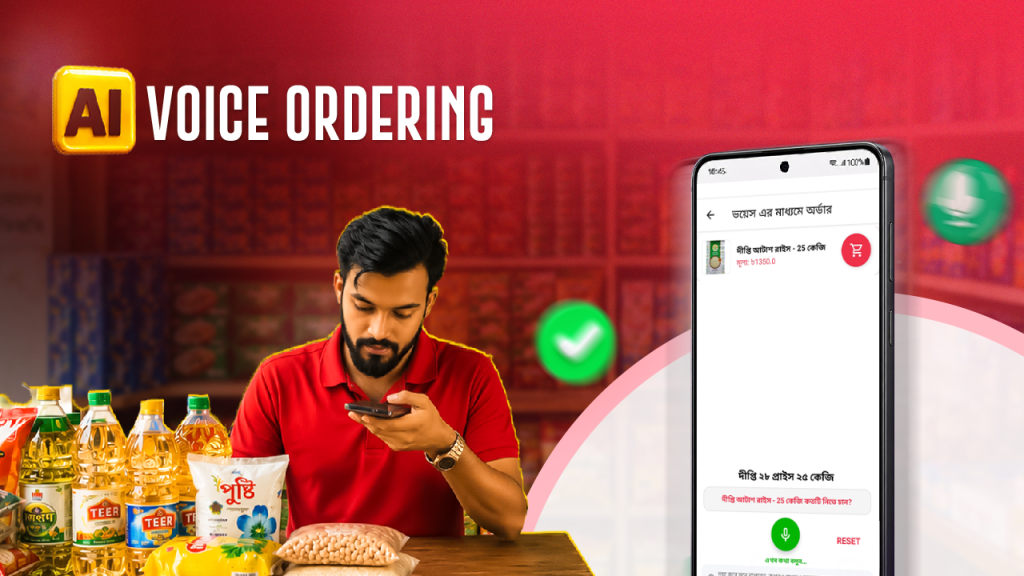
This is not a convenience feature. It is an access feature. It is the moment digital distribution stops being a tool for retailers who are already digitally fluent and becomes infrastructure for everyone else.
The retailer speaks the order in natural Bangla: product names, quantities, delivery preferences exactly how they’d tell a sales rep.
AI parses the request in real time, identifying SKUs, resolving colloquial product names and matching against available inventory in the retailer’s service zone.
Order is confirmed and placed, with credit eligibility checked, delivery time estimated and the retailer’s purchase history updated. No typing. No browsing. No barriers.
Data flows back into the platform, voice orders feed demand signals into PriyoShop’s inventory and route intelligence, making the whole network smarter with every spoken word.
The entire chain learns from a single spoken order.
The Real Insight “Distribution is Infrastructure, Not a Channel”
Most businesses still treat distribution as the last step, the thing you figure out after the product is built. The new model inverts that. Distribution is the first strategic decision. It determines who you can serve, what data you can collect and how fast you can compound your market position.
In Bangladesh’s MSME economy, the stakes are not just commercial. They are developmental. A retailer who can access credit, order efficiently, and compete with modern trade is a retailer who can grow. A brand that can see real demand at the retailer level can make better products for real markets. A distribution platform that earns trust not just transaction volume becomes infrastructure that the whole economy relies on.
PriyoShop is not competing on who has the biggest network today. It is building the kind of infrastructure that earns the right to be the network because it makes every retailer, every brand and every last-mile delivery more intelligent than it was yesterday.
That is not a distribution play. That is a platform play. And in emerging markets, platform plays that start with genuine infrastructure win for a very long time.