
Bangladesh’s Fast-Moving Consumer Goods (FMCG) industry is evolving. From household names such as PRAN, Radhuni, Fresh, Teer, Olympic, Mojo, Savlon and Ispahani to multinational brands such as Unilever, Nestlé, Marico and Reckitt, Bangladesh now has a diverse and increasingly sophisticated consumer-goods ecosystem.
Seeing all the prominent brands uprising day by day, one question arises: How far can Bangladeshi FMCG brands actually go?
The answer depends not only on product quality but also on distribution, technology, financing, consumer data, branding and the ability to build a supply chain that can compete globally.
How Many FMCG Brands are There in Bangladesh?
There is no definitive public database that counts every active FMCG brand in Bangladesh. The market consists of hundreds of established national and international brands, alongside thousands of SKUs and a large number of regional and emerging brands.
One useful indicator of the ecosystem’s scale is PriyoShop, which currently reports 296 brands on its B2B retail platform and more than 250,000 MSMEs within its ecosystem. Its network includes major names such as Unilever, ACI, Square and other leading suppliers.
This represents only the brands participating in one distribution ecosystem, not the total number of FMCG brands operating across Bangladesh.
The real opportunity, therefore, is not simply creating more brands. It is creating stronger brands with better distribution, better data and greater international competitiveness.
Major Challenges Faced by FMCG Brands
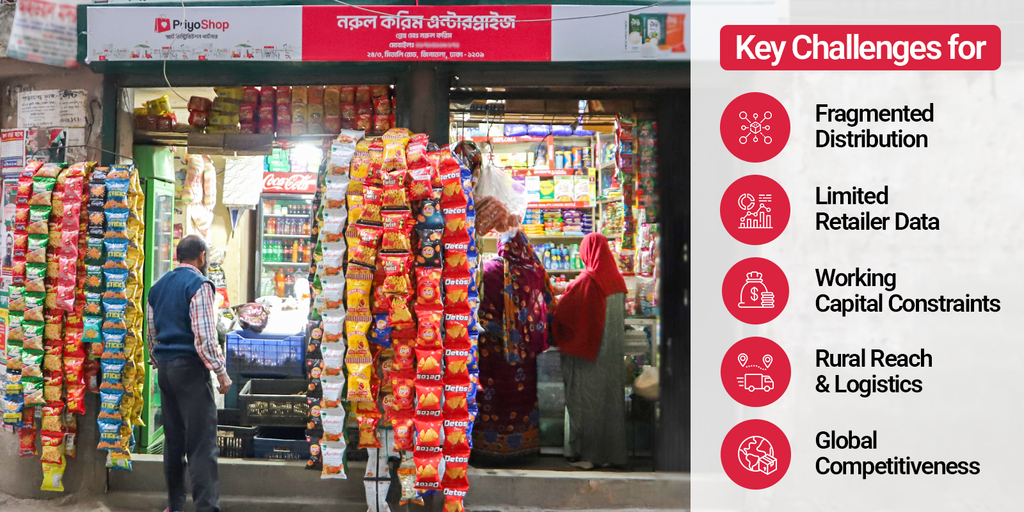
Despite Bangladesh’s enormous consumer market, FMCG companies face several structural challenges.
1. Fragmented Distribution
A large portion of Bangladesh’s retail economy still depends on small neighbourhood stores. Traditional distribution often involves multiple layers between manufacturer and retailer. Every additional intermediary can increase costs, reduce visibility and slow down the movement of information.
For brands, this creates a fundamental problem: they may know how much they sell nationally, but not necessarily what is happening at individual retail points in real time.
2. Limited Retailer Data
Modern FMCG growth increasingly depends on data. Brands need to know which products are selling, where demand is rising, which SKUs are underperforming and when retailers need to restock.
Historically, Bangladesh’s fragmented retail structure made this difficult. The next generation of FMCG growth will therefore depend heavily on real-time retail intelligence.
3. Working-Capital Constraints
Small retailers frequently operate with limited working capital. When they cannot purchase enough inventory, brands lose sales even when consumer demand exists.
This makes access to credit and embedded finance increasingly important not only for retailers but for the entire FMCG supply chain.
4. Rural Reach and Logistics
Dhaka and major cities are comparatively easy to serve. Reaching smaller towns, remote markets and rural retailers efficiently is much more difficult.
Bangladesh’s geography, traffic congestion, seasonal weather and varying local demand patterns make last-mile distribution a major operational challenge.
5. Global Competitiveness
Bangladeshi FMCG brands increasingly have the opportunity to move beyond the domestic market. However, international expansion requires consistent quality, packaging, regulatory compliance, strong branding, competitive pricing and reliable cross-border supply chains.
Producing a good product is no longer enough. A brand must be export-ready.
How is the Industry Solving These Problems?
The answer is increasingly technology-enabled distribution.
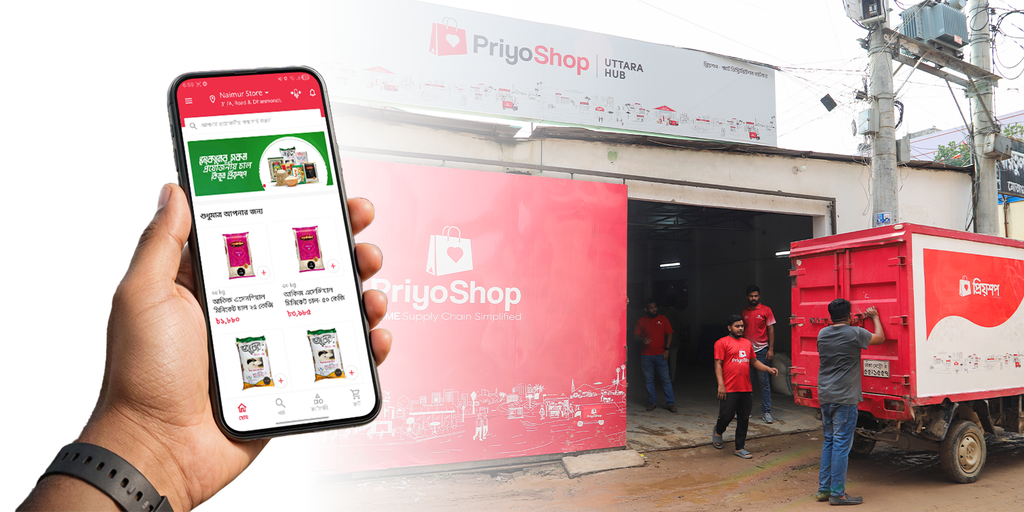
Digital B2B platforms are changing how retailers purchase FMCG products. Instead of physically travelling to wholesale markets, retailers can order products digitally and receive them at their stores.
This reduces procurement time while giving brands greater visibility into retail demand.
Technology can also improve inventory management, demand forecasting and route optimization. PriyoShop, for example, positions its distribution model around real-time retail data, sales-force automation, optimized logistics and expanded distribution reach.
The next step is even more powerful: combining distribution + data + finance + retail media into one ecosystem.
Where does PriyoShop Fit?
PriyoShop is becoming an important infrastructure layer in this transformation.
Its B2B platform connects FMCG brands and suppliers with MSME retailers, allowing shop owners to source products through a digital platform, access wholesale pricing, receive doorstep delivery and potentially access credit facilities.
Its smart-distribution model also aims to help brands reach retailers across urban and hard-to-reach rural markets while providing real-time reporting on sales, delivery and performance.
This creates value on both sides.
For retailers: easier procurement, faster restocking, transparent pricing and access to financial services.
For brands: wider distribution, better market intelligence, improved last-mile execution and new ways to communicate with retailers.
PriyoShop is also building a retail-media layer through Digital Out-of-Home advertising inside retail locations, giving brands another channel to influence purchasing decisions at the point of sale.
In other words, the platform is moving beyond being simply a marketplace. It is attempting to become a retail infrastructure platform.
How Far Can Bangladesh’s FMCG Brands Go?
The potential is significant.
Bangladeshi FMCG brands already have an advantage in understanding local consumers, price sensitivity, cultural preferences and mass-market distribution. As domestic companies improve product quality, packaging, technology and branding, their addressable market can extend beyond Bangladesh into South Asia, the Middle East, Southeast Asia and diaspora-heavy markets.
The next decade could therefore see a shift from “Made for Bangladesh” to “Made in Bangladesh for the World.”
But global expansion will require more than exports. Brands will need international certifications, sophisticated supply chains, strong digital marketing, differentiated product positioning and consistent consumer experiences.
And How Far Can PriyoShop Go?
PriyoShop’s future opportunity is potentially much larger than Bangladesh’s traditional wholesale-distribution market.
Its own strategy increasingly describes PriyoShop as infrastructure for emerging-market retail ecosystems rather than merely a Bangladeshi B2B marketplace.
That distinction matters.
If PriyoShop can successfully combine digital procurement, logistics, embedded finance, retail data and retail media, its model could potentially be adapted to other fragmented emerging markets where millions of small retailers face similar problems.
The global opportunity is therefore not simply selling more products to more Bangladeshi shops. It is building a technology-driven operating system for fragmented retail.
The Bigger Picture
Bangladesh’s FMCG story is ultimately a story about infrastructure.
Great brands need great distribution. Great distribution needs technology. Technology generates data. Data enables better forecasting and financing. Better financing allows retailers to carry more products. And stronger retailers create more opportunities for brands.
This creates a powerful cycle.
The brands that win the next decade will not necessarily be the ones with the biggest advertising budgets. They will be the ones that can combine product quality, consumer trust, distribution excellence, technology and data.
And companies like PriyoShop could play a crucial role in connecting all those pieces.
Bangladesh has already built the brands.
And PriyoShop has built the infrastructure that can take those brands and the country’s retail ecosystem from local scale to global scale.