
Bangladesh’s retail industry is set to grow from $200B to $300B by 2032. Here’s what’s driving it, what’s holding it back, and why last-mile infrastructure decides who wins.
With an estimated market size of $200 billion, the retail sector is a vital engine of Bangladesh’s economy. Driven heavily by domestic consumption, over 70% of the national GDP is tied to consumer spending, with retail alone accounting for roughly 47%.
Two hundred billion dollars. That is the sheer scale of Bangladesh’s retail market today. By 2032, projections show it reaching $300 billion, a steady 5.2% CAGR. Not explosive. Not stagnant. It is the profile of a market maturing.
But the headline number hides the real story. Growth in Bangladeshi retail isn’t coming from glossy supermarket chains multiplying across Dhaka. It’s coming from millions of neighborhood micro-retailers who are finally getting the digital and physical infrastructure to compete. That shift is where the next decade of opportunity lives.
The Numbers Behind the Growth
Retail growth in Bangladesh hasn’t followed a straight line. After dipping during pandemic disruptions, it rebounded sharply and has been establishing a sustainable baseline since.
| Year | Growth Rate | Primary Driver |
| 2021 | -2.3% | Pandemic-impacted consumer spending |
| 2022 | 7.2% | Rebound in disposable income |
| 2023 | 6.9% | Rapid digital shopping adoption |
| 2024 | 1.9% | Expansion of local brands |
| 2025 | 2.8% | Rapid urban population growth |
| 2026 | 3.9% | Supply chain efficiency gains |
| 2027 (proj.) | 3.7% | Increased foreign direct investment |
| 2028 (proj.) | 5.1% | E-commerce & B2B platform expansion |
| 2030 (proj.) | 5.4% | Commercial sector modernization |
The pattern is clear: every acceleration phase is tied to infrastructure, not just shifting consumer demand. Supply chains, digital payment rails, and smart distribution networks are doing the heavy lifting.
Six Forces Reshaping Bangladeshi Retail
Bangladesh’s retail transformation is being driven by more than market growth. Changes in where people live, what consumers expect, how retailers source products, and how distribution networks operate are reshaping the sector from the ground up.
- Retail growth is moving beyond major cities: As secondary and tertiary cities expand, new consumption clusters are emerging beyond Dhaka. This is creating demand for better product variety, consistent pricing, reliable availability, and more organized retail experiences.
- Consumer expectations are rising: Today’s consumers are more connected, informed, and selective. They increasingly look for recognizable brands, dependable quality, authentic products, and consistent availability, putting greater pressure on retailers to source better and stock smarter.
- Digital access is reducing the location gap: A retailer in Netrokona can increasingly access the same digital ordering infrastructure as a merchant in Gulshan. For a market where distribution has historically limited access, technology is making location less of a barrier to participation.
- Distribution is becoming a competitive advantage: Demand alone does not guarantee growth if products cannot reach the right stores at the right time. Smarter procurement, stronger distribution networks, and efficient last-mile execution are making availability a critical part of retail competitiveness.
- Traditional retailers are becoming connected retailers: Neighborhood shops are gradually moving beyond manual ordering and dependence on physical sales visits. Digital ordering, payments, inventory visibility, and other business tools are helping retailers operate with greater speed, visibility, and control.
- Data and finance are becoming part of the retail infrastructure: Distribution is evolving beyond simply moving products. Transaction data can improve demand visibility, while embedded finance can help eligible retailers address working-capital constraints and keep the right products on their shelves.
Together, these shifts point to a larger transformation: Bangladesh’s retail future is not simply about building more modern stores. It is about making the infrastructure behind millions of existing neighborhood retailers more connected, accessible, and efficient.
What is Actually Holding the Market Back
Bangladesh’s retail ceiling isn’t consumer appetite. It’s structural plumbing.
Informal market fragmentation keeps margins paper-thin and price volatility high. Inefficient supply chains lead to stockouts and delivery delays, compounding problems for small retailers who cannot afford to hold buffer inventory. Added regulatory friction creates cost barriers for small merchants trying to modernize.
These aren’t abstract industry challenges. They are daily operational realities for the millions of neighborhood mudi dokan owners who form the backbone of Bangladesh’s economy, the very merchants routinely ignored in high-level retail conversations.
Where PriyoShop Fits In
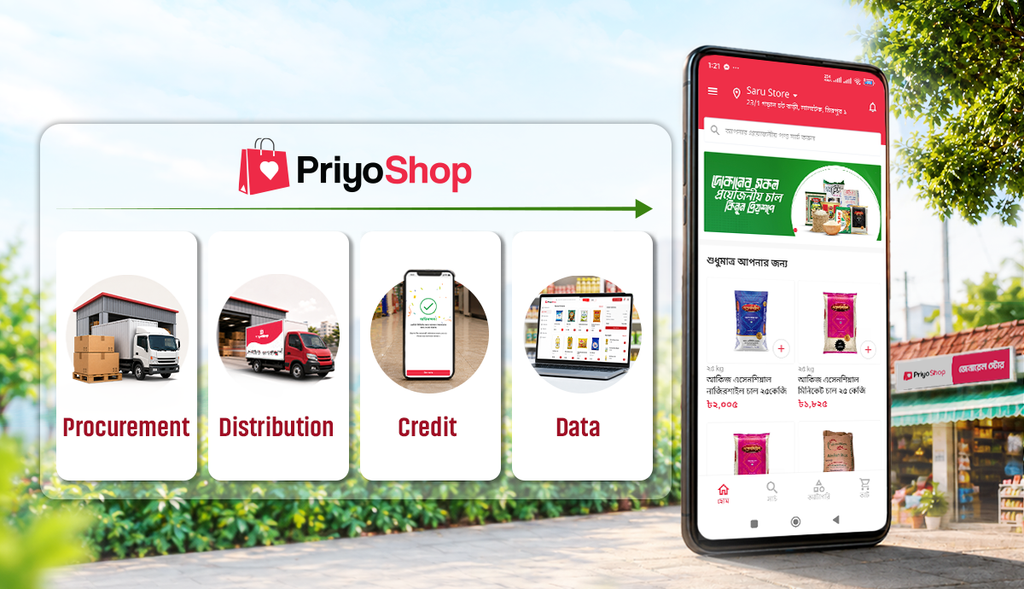
Bangladesh does not need to replace its neighborhood stores to modernize retail. It needs better infrastructure behind them.
That is where PriyoShop comes in.
Rather than competing with traditional retailers or building another supermarket network, PriyoShop strengthens the infrastructure that already powers everyday commerce connecting retailers, brands, distribution, finance, data, and last-mile delivery through one ecosystem.
Bringing Supply Closer to Demand
Through 43 logistics hubs, inventory moves closer to retailers across regional markets. This reduces dependence on Dhaka-centric supply flows and helps products reach stores faster and more consistently.
Turning Working Capital Into Inventory
For many small retailers, demand is not the problem, cash flow is. Embedded micro-credit gives eligible retailers access to collateral-free working capital, helping them replenish inventory without waiting for cash to cycle back into the business.
Turning Retail Activity Into Market Intelligence
Every order creates a signal. PriyoShop’s real-time data intelligence gives brands greater visibility into what retailers are ordering, where demand is developing, and how products are moving across the network bringing decision-making closer to actual market activity.
Making the Last Mile Faster
A connected ordering and distribution network shortens the distance between demand and delivery. Accelerated last-mile fulfillment helps retailers replenish faster, reduces availability gaps, and keeps products moving toward the point of purchase.
But the impact of better retail infrastructure extends beyond commerce.
In PriyoShop’s Netrokona hub network, retailer procurement speed has increased by 100%. At the same time, 54% of the hub workforce is under 30, with 100% local employment.
That matters because retail infrastructure should do more than move products.
It should move local economies forward.
When inventory moves faster, retailers can operate better. When retailers grow, brands gain stronger market access. And when infrastructure is built locally, commerce can create jobs and economic opportunity within the communities it serves.
PriyoShop is not changing what makes Bangladesh’s retail network unique. It is building the infrastructure that helps that network work better.
The Next Six Years
The next chapter of Bangladesh’s retail growth will not be defined by market size alone. It will be defined by how efficiently that market can move.
By 2032, the opportunity is not simply to serve more consumers, but to build a retail system capable of serving them better through stronger supply networks, faster distribution, deeper access to working capital, and better use of data and technology.
For a small retailer in Kaliganj, progress should mean more than simply selling more. It should mean knowing what to stock, accessing inventory when it is needed, securing working capital to keep shelves full, and receiving products without unnecessary delays.
When millions of neighborhood retailers gain that capability, the impact goes far beyond individual stores. Supply chains become stronger. Brands reach deeper into the market. Local businesses become more productive. And retail growth becomes more inclusive.
Bangladesh’s retail market is heading toward its next $100 billion in scale. But the bigger story is the infrastructure being built underneath that growth.
The future of retail will not be shaped by demand alone. It will be shaped by how intelligently we connect demand, supply, finance, data, and distribution.